Introduction & History Of Kawasaki Bikes
The story of Kawasaki Company goes back to 1924, at that time involved into metallurgy and the aircraft industry. In 1949, they decided to enter the motorcycle industry producing engines that could be adapted to motorcycles.
In their line, you could find a 60cc two-stroke, as well as a 150cc and a 250cc four-stroke engines developed with technology from BMW, company with whom they had had relationships since their beginnings in the aeronautical industry. It was not until 1954 that Kawasaki Motorcycles produced their first complete motorcycle under the name of Meihatsu (a subsidiary of Kawasaki Aircraft Co.). Almost at the same time, they also tried to introduce their own line of scooters to the market, but they soon realized they could not compete against the two giants of the scooters industry for those days: the Fuji Rabbit and the Mitsubishi Silver Pigeon.
But we cannot talk about Kawasaki without mentioning another make that will definitely help Kawasaki become as well as Honda, Suzuki, and Yamaha one of the big players in the Japanese Motorcycles scene: Meguro Motorcycles, better know in that time as the "senior make and the king of four strokes".
Meguro entered the motorcycle industry in 1937. Having a good relationship with the government, the people at Meguro took advantage of the army orders. Their first motorcycle was the Z97: a 500cc rocker-valve motorcycle influenced by the Swiss Motosacoche. It is worth mentioning that this model was a success for the factory and the Z97 was in production until the fifties.
Along the years, Meguro produced some very nice 250cc and 350cc rocker-valve, single cylinder models as well as high performance twins. All of them had a very strong British influence. And thanks to the commercial success they were living, they also launched a rocker-valve 125cc for their low end range and a twin cylinder 650cc to accompany the already existing 500cc.
But it was in 1958, when Meguro tried to get rid of their British influence that things started to go wrong. Based on a winning prototype of Mount Asama (one of the biggest races that time), Meguro Motorcycles produced three nice and elegant machines with overhead camshaft—the 125cc E3, the 250cc F and the 350cc YA. Unfortunately, these bikes turned out to be too heavy and did not get the buyers' attention.
Meguro will soon return to rocker valve models. Meguro Motorcycles remained as one of the top 10 manufacturers until 1960, but due to some bad decisions, as the ones mentioned above, the company started to decline and was soon bought by Kawasaki. In 1960, Meguro signed an initial agreement with Kawasaki Motorcycles, and in 1962, they had completely disappeared. And this brings us back to Kawasaki Motorcycles.
In 1960, the company decides to give a serious push to the motorcycle division of Kawasaki Aircrafts. They take out of the market the Meihatsu brand; they build their own plant of low end and low powered machines and buy Meguro. In same year, their first motorcycle rolled off the line, a 125cc two stroke.
Helped by the knowledge of the Meguro company which Kawasaki had taken over (Meguro was the oldest motorcycle company in Japan), the company moved into the production of big bikes around 1966. The model was called the W1 (650cc).
The W1 was not such a success because all the rival bikes were still faster, lighter and provided better steering. So, Kawasaki developed two lighter versions A1 Samurai (250cc) and the A7 Avenger (350cc). These bikes ended up being a little more successful.
In 1969, Kawasaki started to develop a name for itself with bikes with very high performance, the start was the H1 model (500cc) also known as the Mach III. The H1 was excellent for wheelies due to its backward weight layout. It gulped a lot of fuel and had a hard core reputation. Two smaller versions were also released, the S1 (250cc) and the S2 (350cc). In 1972, a bigger version of the original was produced called H2 or Mach IV (748cc). The production stopped when emission rules got too strict in the mid 70’s.
Even if the H models did not handle well, Kawasaki developed a super bike which no other manufacturer could compete with at the time. The Z1 from 1973 was a 903cc engine but it was first planned as a 750cc engine. However, Kawasaki waited and improved the engine because of the Honda CB750 introduction in 1968. Z1 had a great reputation and was very popular due to the price and performance ratio. The name “king” was its alias. In 1976, the Z1 became the Z900 and the engine was improved. Later, the Z1000 was launched because of more engine power.
Towards the end of the 1970’s, Kawasaki developed a few smaller “zed” bikes like the Z650 which was introduced in 1977. And a big “zed” Z1300 which was also partly engineered as to out-perform the other Japanese companies with a bigger, stronger and heavier bike. But Japan still had to learn that bigger was not always better and the Z1300 was not a big success to the company.
Kawasaki built a nicely full fairing bike with a strong engine and an outrageous performance called the GPZ900R (908cc). It was very popular both on the race track and on the road. And it was a comfort to ride.
In the beginning of the 1990’s, all the Japanese manufacturers were competing very hard in the super bike models and any advantage above the other would bring credit and success. Kawasaki stepped right up and took that credit with the development of the ZZR-1100 (1052cc) which was launched in 1990 and became the fastest production bike for 5 years.
The ZZR-1100 was popular not only for its speed and power but also the strong frame and good suspension made it a good tour motorcycle. Also, it was very fast. In 2002, Kawasaki replaced it with the ZZR-1200, which was designed for more middle end power and better handling. And a smaller ZZR 600 had also joined the lineup of ZZR’s earlier on in the production.
In 2000, Kawasaki had already launched an ultra super bike called the ZX-12R (1199cc). Its pure weight, unique frame and 176 bhp was enough to blast most bikes away.
Kawasaki had lost some of the reputation for performance by 2000 but Kawasaki President Shinichi Morita had promised that Kawasaki would be back and indeed, with the arrival of the ZX-12R and the ZX-6R, Kawasaki did make a nice comeback.
The ZX-6R was already launched in 1995 but the 2003 new ZX-6R (636cc) had been truly redesigned and engineered into a new aggressive fast racing machine. Kawasaki has taken.
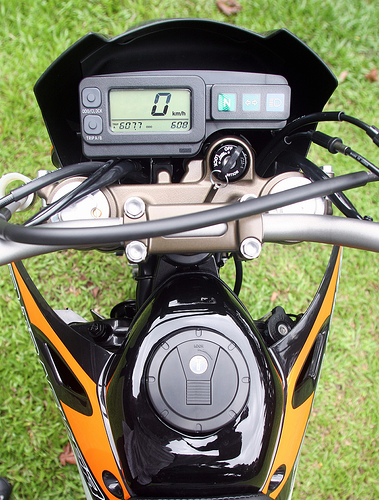
For starters, the bike sits way above traffic, with the handlebars clearing all but the tallest MPVs and SUVs.
The high seating position means you can see for hundreds of metres in front, even above the car in front of you - which is great since most car drivers in KL have a habit of jumping on the brakes.
You sit upright, with your weight off your wrists - which is good for long rides.
The bike is also narrow compared to most other types of bikes, making filtering through heavy traffic a breeze.
In fact, after a few days I realised even the Kapcais were having a tough time catching up with the tall motard in traffic.
Another thing that many riders might be interested in is that the D-tracker has loads of suspension travel in it's front forks.
At 28.4 cm - it's so long that it makes the bike look like it's standing on stilts.
This means you can glide over all but the biggest potholes without even feeling them.
I hardly slowed down when I passed the entrance to my housing estate - which is incredible since with so much construction going on, it resembles a Martian landscape more than a road.
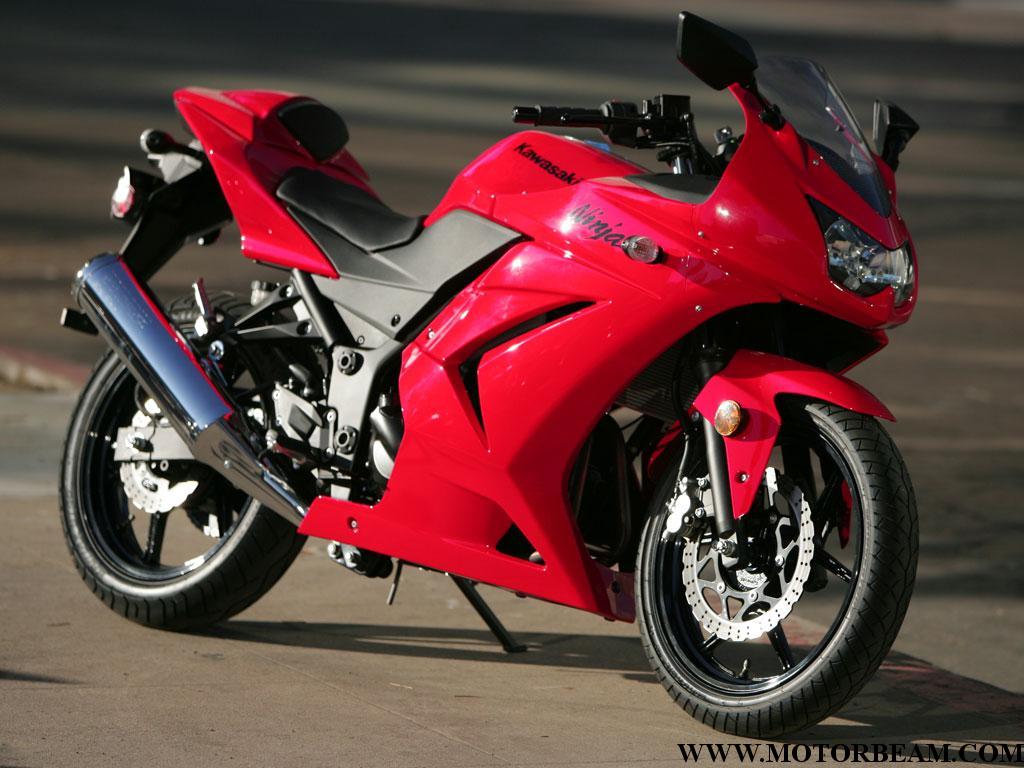
Bajaj To Launch Kawasaki Ninja 250cc Bike By May In India
launch the Kawasaki Ninja 250cc bike in India by next month. The bikes are ready and set to roll out after launch to the buyers.
Kawasaki Ninja 250cc bike is manufactured in Thailand and that is where the bike is coming to India and due to the Free Trade Agreement that India and Thailand have, Bajaj is making the most of it due to the low custom duty and hence importing the bikes are CBU units.
Kawasaki Ninja 250cc bikes are priced around Rs 90000 in Thailand (ex-factory price). After paying custom duties, the bike will cost less than Rs 2 Lakhs, making it possible for Bajaj to sell for around Rs 2 - 2.2 Lakhs (ex-showroom).
MOTOR BIKES FREE STYLE VIDEOS
Watch and download. |
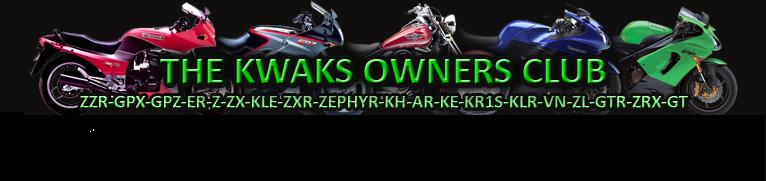
Welcome to The Kwaks Owners Club website!
This club is dedicated to all things Kawasaki, all kinds of bikes, from Learner Legals to Cruisers to Supersports, Old and New. If you own and ride a Kawasaki Motorbike then this club is for you. Please have a look around our site and if you would like to get in contact with us regarding the Club, Membership or anything else please use the form provided on the Contact Page
Kawasaki D-Tracker 250 review
The D-Tracker is basically a Kawasaki KLX-250 'scrambler' with 17-inch street rims
It used to be the motorcycling crowd could be divided cleanly between superbikers and off-roaders.
The superbikers hang around at Hard Rock Cafe and go riding to Genting on the weekends.
The off-roaders on the other hand spend most of their time jumping in the jungle and are rarely seen.
But now, a strange hybdrid of the two is forming on the fringes of the local biking scene.
Supermotos, or also known as supermotards are fast gaining popularity.
For those who don't know much about bikes, a supermotard is basically a scrambler with superbike tyres.
You would think that a tall scrambler would be horrible to ride around twisty roads.
But as I rode the Kawasaki D-Tracker around some sharp bends in the neighbourhood - this myth was quickly proven to be untrue.

It used to be the motorcycling crowd could be divided cleanly between superbikers and off-roaders.
The superbikers hang around at Hard Rock Cafe and go riding to Genting on the weekends.
The off-roaders on the other hand spend most of their time jumping in the jungle and are rarely seen.
But now, a strange hybdrid of the two is forming on the fringes of the local biking scene.
Supermotos, or also known as supermotards are fast gaining popularity.
For those who don't know much about bikes, a supermotard is basically a scrambler with superbike tyres.
You would think that a tall scrambler would be horrible to ride around twisty roads.
But as I rode the Kawasaki D-Tracker around some sharp bends in the neighbourhood - this myth was quickly proven to be untrue.
The D-Tracker is basically a Kawasaki KLX-250 'scrambler' with 17-inch street rims.

It is powered by a single-cylinder 250cc thumper that lacks any sense of urgency - and can power the 119 kg bike to a mere 145 kph.
However, despite the lack of straight line speed - this bike can be quite a load of fun in the twisties.
You will also learn a totally different away of doing essentially the same thing - that is going around corners quickly.
To do this, sportsbikers lower their center of gravity by dropping their body toward the inside of a turn and putting their knees down.
Supermoto riders on the other hand adopt a totally different approach.
Unknown to many, the fastest way around a turn is actually by sliding through it.
The supermoto rider sit high up on his bike and uses a skillful combination of brakes and clutch to 'slide' the rear tyre and change the direction of the bike.
It is a neat trick - this. Think of it as drifting - but on just two wheels.
It is this sliding that makes the supermoto rider adopt his typical 'foot-out' pose. This position is necessary to prevent the bike from sliding too much and dumping the rider on the tarmac. It's just not to look cool in photos. 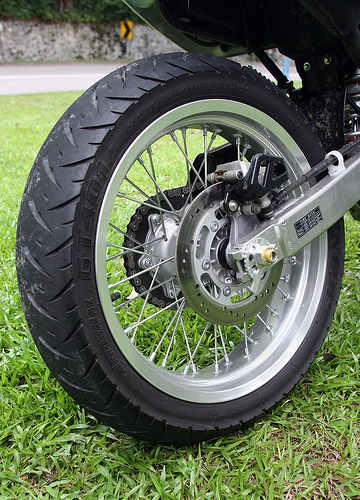
There are a few downsides to the bike though - the miniscule petrol tank can only hold 7.5 liters of fuel - giving you a range of just over 100kms.
Because of it's height - the bike is also unstable at very high speeds.
But in all other respects, it's a practical enough bike. In fact, if the price were around RM15,000, I think I would buy one right now - just to commute.
Think of it as sort of a giant Kapcai. The only difference is you can pretend to be a supermotard rider and wear really cool helmets and riding gear.
The D-Tracker comes in an assortment of three colors: black and candy blue, black and orange as well as Kawasaki green.
For more information, call Sunrock Kawasaki at 03-55665688.
ICon of kawasaki Motor Bikes |



.jpg)
